


Madden could truly benefit from a hiatus.
For over three decades, the annual NFL simulation giant has been a late-summer fixture in the video game realm, offering the most lifelike representation of National Football League action available. The teams are included, the players are featured, and everything a football enthusiast desires from an official simulation is present in Madden NFL 25.
Being an enthusiastic fan myself—by the way, Go Birds—the yearly release of Madden ought to excite me for the upcoming season. Just a few years back, it did; Madden signaled that the NFL season was nearing, and its digital counterpart made the final month of waiting for the real games more bearable.
Order Madden NFL 25: Amazon | Best Buy | GameStop
But now, as I eagerly await real Eagles football this September, my outlook on Madden has shifted to a place no video game, especially not the official simulation of one of the nation’s favorite sports, should ever leave its audience: Indifference.
Introducing the boom
The standout enhancement to Madden 25’s football mechanics is Boom Tech, a comprehensive overhaul of the physics representing the game's physicality. Countless small, nuanced animations have been integrated at every point of contact during gameplay, and the outcomes are noticeably improved from previous iterations. In fact, I’d argue this offers the finest on-field experience Madden has ever delivered.
Every subtle detail—the defender’s angle, the ball-carrier’s speed, the hand the runner uses to carry the ball, and so on—impacts each play’s outcome due to this redesign. Football is often described as a game of inches, and these additional physics-based features make it feel like I’m genuinely earning that extra yard while being tackled.
Watching it in action is fascinating, and precise execution yields extremely satisfying results. Bringing an opponent down in open play offers a gratifying snap, almost as if John Madden himself is shouting “BOOM!” in my ear when I perfectly time the tackle. Breaking through the offensive line to sack the quarterback feels rewarding and deserving of the ensuing silly celebration.
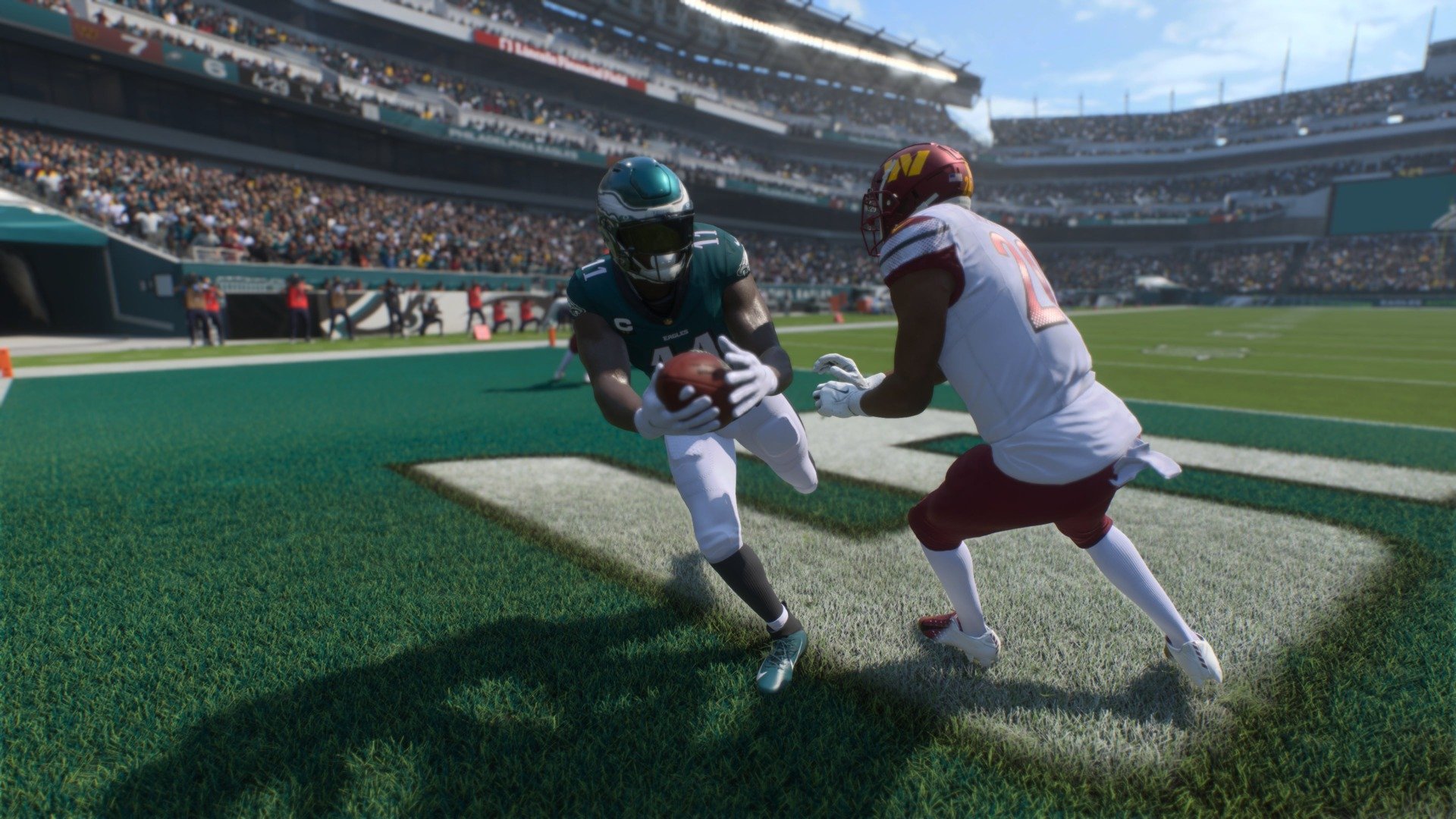
Furthermore, celebratory moments like these gain an added layer of authenticity thanks to this new system. During one play, DeVonta Smith caught a 30-yard pass for a first down, and upon being prompted, I chose for him to perform a little dance. The dance concluded with the classic hand signal for a first down—arm extended in a chopping motion, for those unfamiliar.
However, as Smith fully extended his arm, a defending player crossed into the shot and collided with Smith’s arm. Suddenly, the two players began exchanging words, with Smith’s hand still resting where it made contact with the defender. It may seem minor and the moment was fleeting, but interactions like this bring Madden closer to resembling a genuine NFL TV broadcast.
(Additionally, speaking of celebratory dances: Following a fumble recovery for a touchdown, the scorer and another defender executed the Fusion Dance from Dragon Ball Z as a celebration. While not a major element, it certainly elicited a big cheer from me.)
Screenshot: EA / Jason Fanelli
Wait, what did he say?
One aspect that detracts from that “actual TV broadcast” sensation, however, is the commentary team. This year’s game includes three different commentary teams, featuring the first-ever female commentator, Kate Scott. Generally, they perform well in narrating the action, despite the clear audio file stitching used to form sentences. Mike Tirico’s tone at the end of a quarter is particularly odd, as he says “We’re Back! [slight loading] From Philadelphia! [slight loading again] After this!”
Occasionally, however, the game loads incorrect context, resulting in entirely inaccurate commentary. During a match against the Vikings, I sacked Sam Darnold for a significant loss. Both Mike Tirico and Greg Olsen began discussing how this was my “third consecutive sack,” suggesting I had sacked the quarterback on the previous two plays, and how damaging that was for the offense.
The issue is, the sack occurred on 2nd and 2, meaning the prior play was a positive gain for the offense, certainly not a sack. Upon pausing and reviewing the stats, I discovered it was indeed my third sack of the game, but not on consecutive plays. It’s a minor oversight, but one that diminishes Madden’s authenticity.
Despite the commentary, I’ve spent a fair amount of time praising Madden 25‘s gameplay after stating the series needs a break, which might seem contradictory. However, this highlights the frustration with the lack of depth in other areas of the game. The core product—simulated football—is exceptional; it’s the surrounding elements that are stagnant.
Multiplatform
Madden NFL 25
BACK OF THE BOX QUOTE
"Ultimate Team!...Oh, and football too, sure."
TYPE OF GAME
Professional football simulation
LIKED
Playing the actual game of football.
DISLIKED
The lack of depth of everything else around it.
DEVELOPER
EA
PLATFORMS
Xbox Series X/S, Xbox One, PlayStation 4, PlayStation 5, PC
RELEASE DATE
August 16, 2026
PLAYED
20+ hours, including multiple quick play games, building a team in Madden Ultimate Team, running the Eagles in Franchise mode, and creating a running back in Superstar mode.
Franchise and Superstar modes spotlight this issue. Franchise mode allows you to manage an NFL franchise, overseeing everything from roster building to coaching staff management to strategizing your team’s overall approach on the field. Superstar mode, on the other hand, focuses on a single player, where you start as a rookie fresh out of college, drafted into an NFL team, and navigate through the created player’s career. Both modes predominantly involve navigating menus, as most off-field decisions in both modes are handled through these menu screens. When they do offer something different, aside from playing football, the experiences are brief and lack substantial interest.
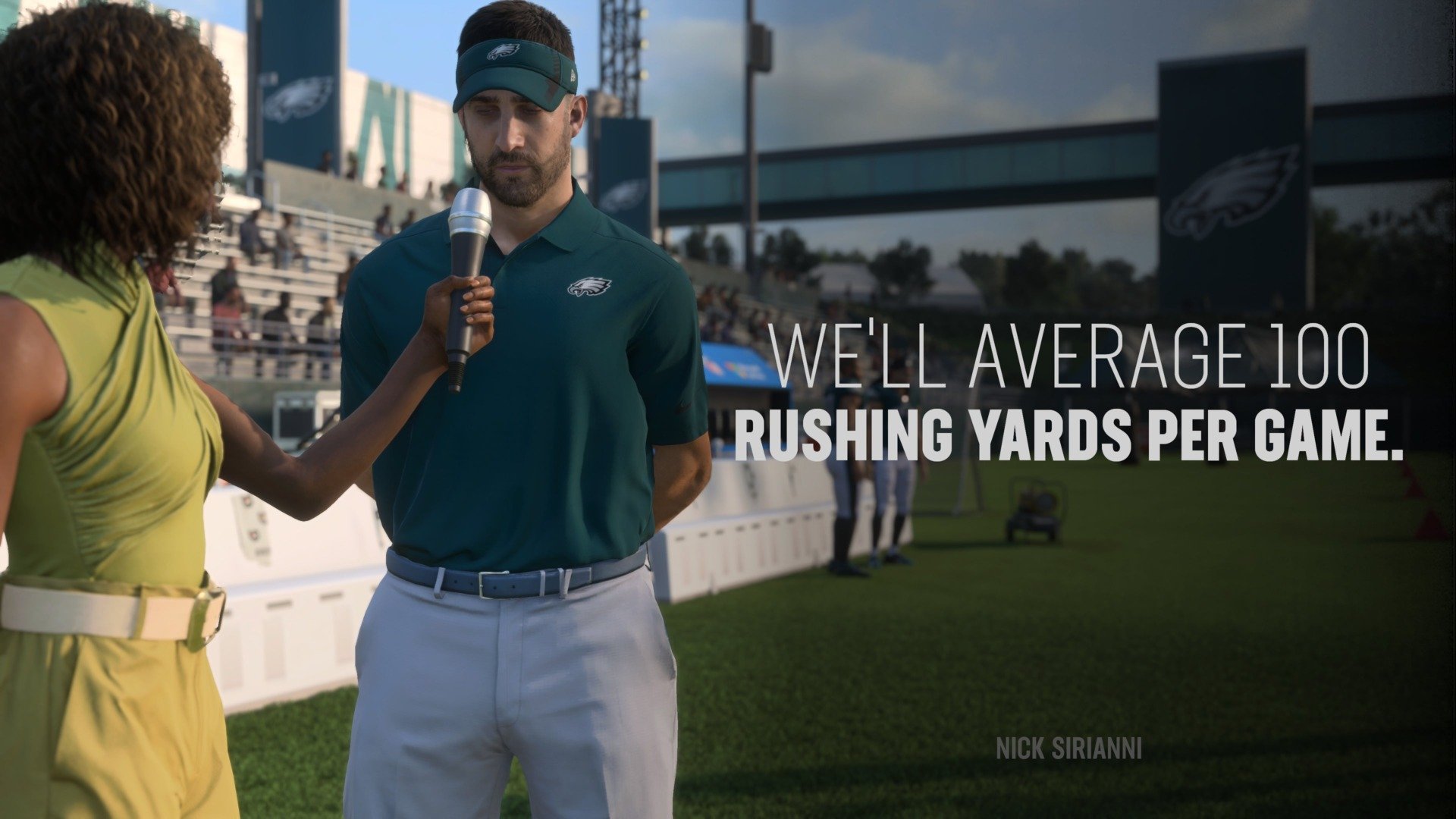
Consider, for instance, Franchise mode: As I launch my franchise with Nick Sirianni and my Eagles, I’m presented with the option to participate in a sideline interview from the practice field. The reporter asks which aspect of the team concerns me most for the upcoming season, giving me the option to select “the offense” or “the defense.”
Now, maybe I’ve played too many RPGs over the years, but with these dialogue choices, I expect that whichever I select will be elaborated upon in the subsequent dialogue. I might choose “the offense,” anticipating Sirianni might say something like “The offense struggled towards the end of last season, but we’re aiming to work hard and return to our usual success” or something along those lines.
But no. I select “the offense,” and then big white letters flash “THE OFFENSE” on the screen, implying Sirianni responded with just two simple words, no elaboration. For a franchise that strives for authentic experiences, this is simply not how many NFL coaches—except perhaps Bill Belichick preparing for Cincinnati—would answer that question, and I couldn’t help but chuckle. Both Franchise and Superstar modes have awkward conversations like this, making them feel more uncomfortable than engaging.
I understand these elements aren’t the main focus of Madden, but for a franchise that claims authenticity, failing to apply it to these moments makes those claims seem insincere. Moreover, while Franchise and Superstar modes lack focus, another mode certainly does not.
Screenshot: EA / Jason Fanelli
MUT MUT MUT
Madden Ultimate Team has clearly become the franchise’s leading mode, and it’s evident. Upon launching the game, the first task is to begin building your Ultimate Team by opening packs and engaging in a few tutorial challenges with the players you acquire. After that, you’re inundated with advertisements for the current MUT season, MUT deals, and MUT-themed bundles, all designed to keep you returning to MUT even after attempting to exit it.
I’m not exaggerating when I say that a full hour elapsed between my initial game boot and my ability to play a standard exhibition football game. During that time, I exited Madden Ultimate Team three times; once after the initial tutorial, and twice more after in-game ads pulled me back in. Then, upon finally reaching the main menu, the order of selections began with Madden News, followed by Ultimate Team, and then Quick Play. MUT now sits above the standard gameplay mode, as if EA’s dedication to its card-based cash cow couldn’t be more apparent.
Is MUT enjoyable? Certainly! Building a team with randomized packs of players and then playing football with that team is entertaining, and the rush from pulling a top-rated player is exhilarating. However, the way Madden 25 is structured to steer players toward MUT, even after they’ve already paid the initial “retail price” entry fee, has a “used-car salesman” vibe I could do without.
I’m not naive enough to believe Madden will ever cease its annual releases. However, it’s clear the franchise is overdue for a significant overhaul, especially this year with its new competitor College Football 25 completely overshadowing it.
While the core gameplay of Madden 25 is excellent, there are significant issues with everything surrounding the on-field action. Franchise and Superstar modes are neglected while MUT is pampered. Commentary offers moments of brilliance but often feels awkward or inaccurate. For every moment of triumph, there’s a moment of frustration.
The seasoned veteran known as the Madden franchise is showing signs of age, with Madden NFL 25 being the latest example. Although I don’t foresee it being retired, it might be time for the old coach to take a year off to revitalize its strategy.
Order Madden NFL 25: Amazon | Best Buy | GameStop