


Dustborn reminds me of a well-intentioned friend who juggles too many responsibilities to please everyone. Red Thread Games’ mix of adventure, rhythm, and beat-em-up genres has its merits. When it embraces its role as a socially aware, modern take on a Telltale Games adventure, the tales of its superpowered misfit ensemble truly captivate. But when it shifts into a mediocre beat-em-up, sacrificing relationship development for lackluster combat reminiscent of the Wii era, my interest wanes.
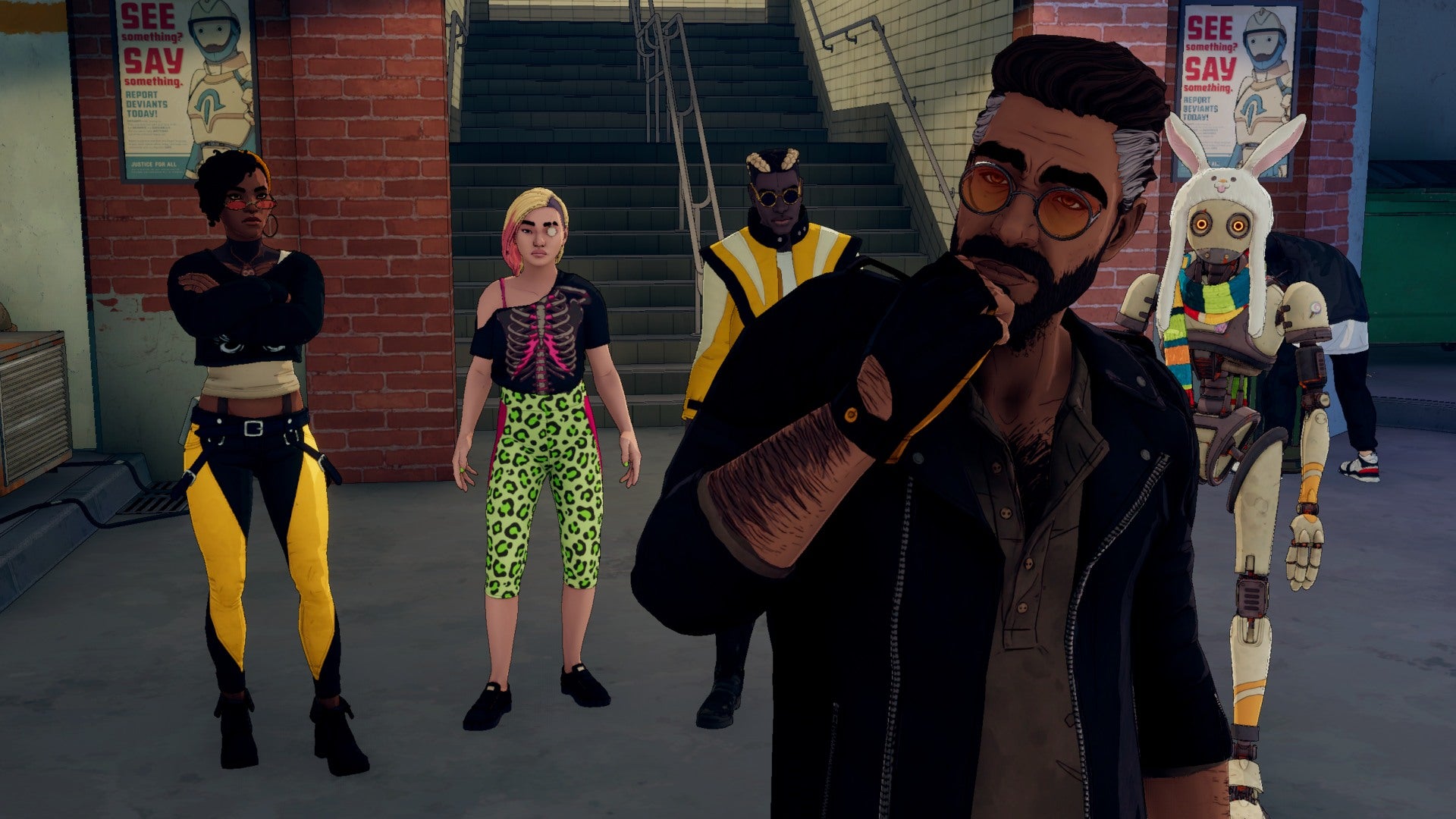
Dustborn seems to be ambitiously tackling too much, making it feel like a rough draft encompassing every idea the team envisioned. It overflows with mechanics, characters, and themes that sometimes appear forced and underdeveloped, as if they were included regardless of whether the game could handle them effectively. The diverse backgrounds and cultures of its predominantly superpowered nomads reflect a growing group traversing a dystopian America. However, as the tour bus fills, it becomes evident that not every character will have the same opportunity for growth.
Screenshot: Red Thread Games / Kotaku
Midway through Dustborn, I realized that not all characters received equal attention. Pax, the protagonist, encounters nearly a dozen individuals who join her cross-country journey, each initially possessing a unique path influenced by your choices. For instance, Theo, the leader of the mutant smugglers, may see Pax and her crew as equals, employees, or surrogate children by the game’s end. The game constantly highlights how your treatment of him influences his responses, leading to specific endings based on your relationship. This is an intriguing, albeit overt, method of illustrating how your interactions can shape someone’s perspective.
Unfortunately, this mechanic is absent for characters introduced in the second half of the game. These less adaptable characters often feel like plot devices to extricate Pax and her friends from tricky situations or create drama that never fully materializes, ultimately feeling like undeveloped ideas. This issue extends beyond character writing, affecting a story that struggles to maintain focus.
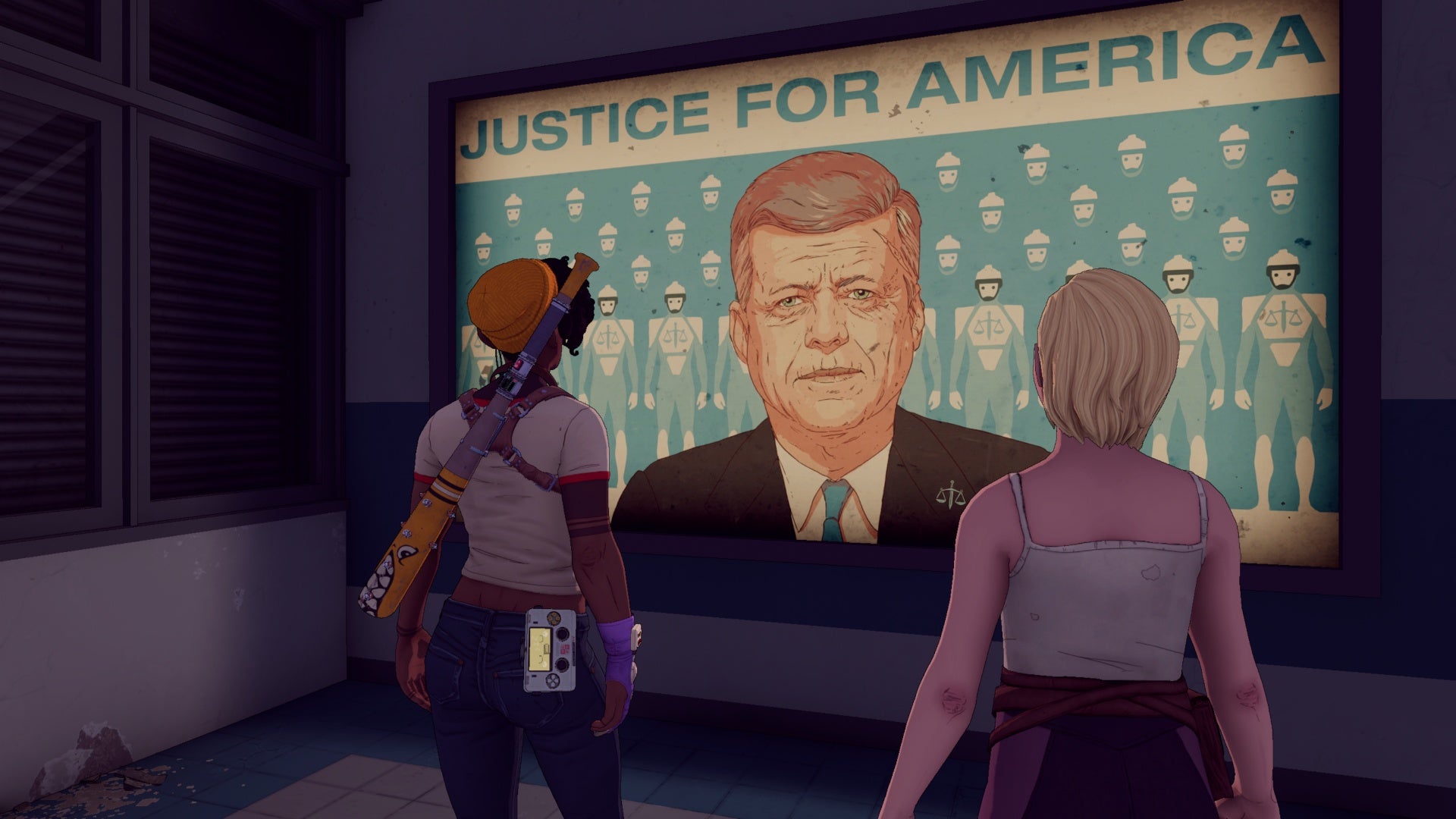
Dustborn begins with a clear premise. Pax, her friend Sai, and her ex Noam collaborate with Theo as a covert punk band smuggling a data key across an alternate-future America. In this world, it wasn’t President John F. Kennedy who was assassinated in 1963 but his wife, Jackie Kennedy. In response, the president established Justice, a policing force that devolved into fascism, especially targeting “Anomals,” superpowered individuals who can manipulate elements with their voice. Pax can evoke negative emotions vocally, while Noam can calm situations. Their mission is to traverse the country undetected to complete their task and find a better life.
Screenshot: Red Thread Games / Kotaku
This premise provides a solid foundation for the road trip, but each time Pax’s bus stops, a new character, conspiracy layer, or crew detail emerges. By the time I was halfway across America, Dustborn felt burdened by its ambitions. The team clearly aimed to address various cultures, conflicts, themes, relationships, and character archetypes, yet with each expanded focus, it seemed to lose sight of its strong foundation. The grounded narratives began to feel overshadowed by the chaos.
There are elements of Dustborn that I struggle to describe coherently because they appeared and disappeared so swiftly that I never fully grasped their intent. Entire sections felt like diversions into unfinished stories, with constant shifts in stakes and massive lore dumps that felt disconnected. Dustborn excels when exploring how a persecuted group navigates a cynical, fascist America while seeking hope and connection. Yet, these ideas are often derailed by awkward genre-blending that never delivers. Entire characters are lost in the final moments, swallowed by the convoluted turns Dustborn takes, leaving me questioning why the game expanded into a chaotic mix of elements when it already had enough.
Screenshot: Red Thread Games / Kotaku
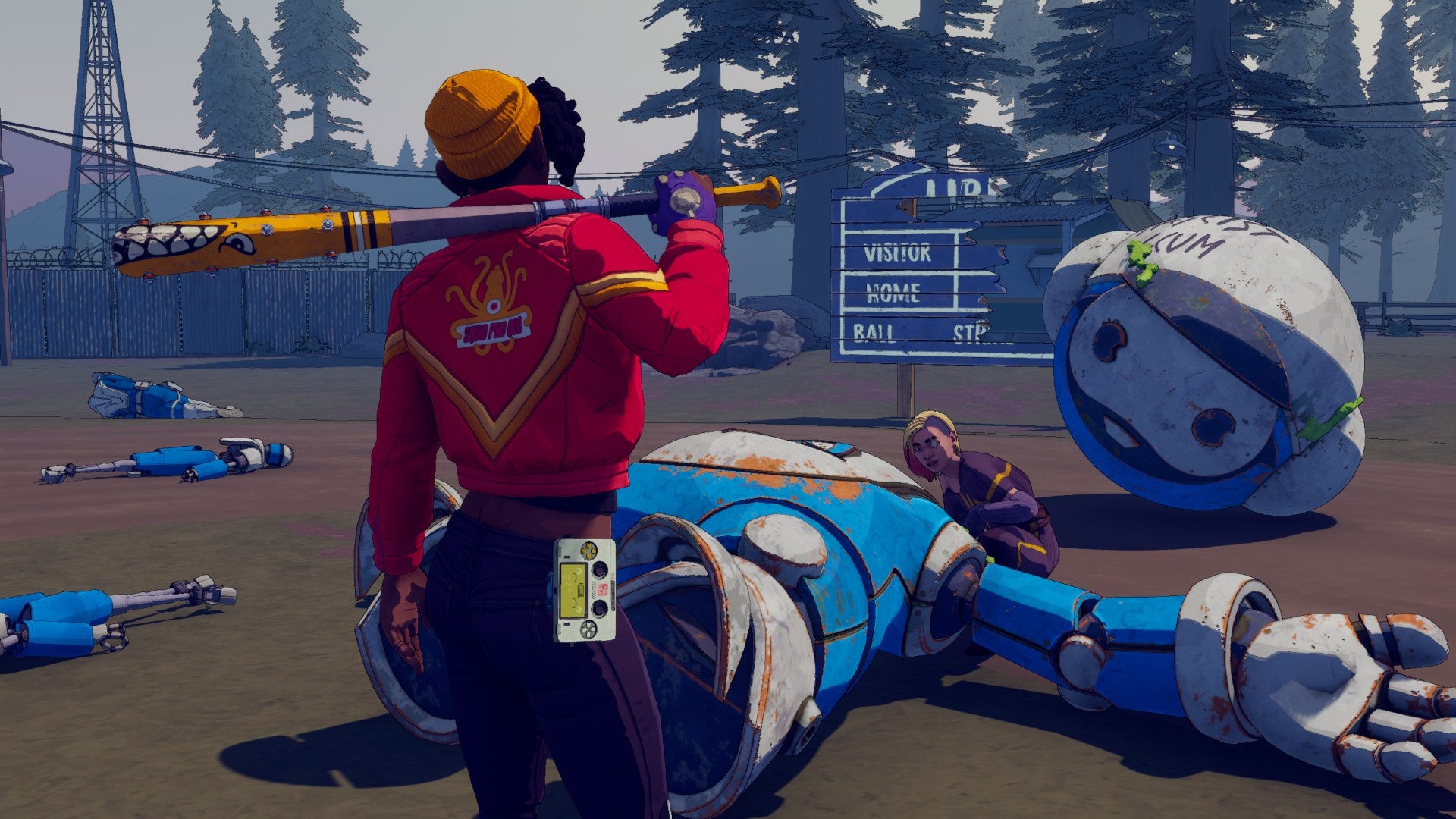
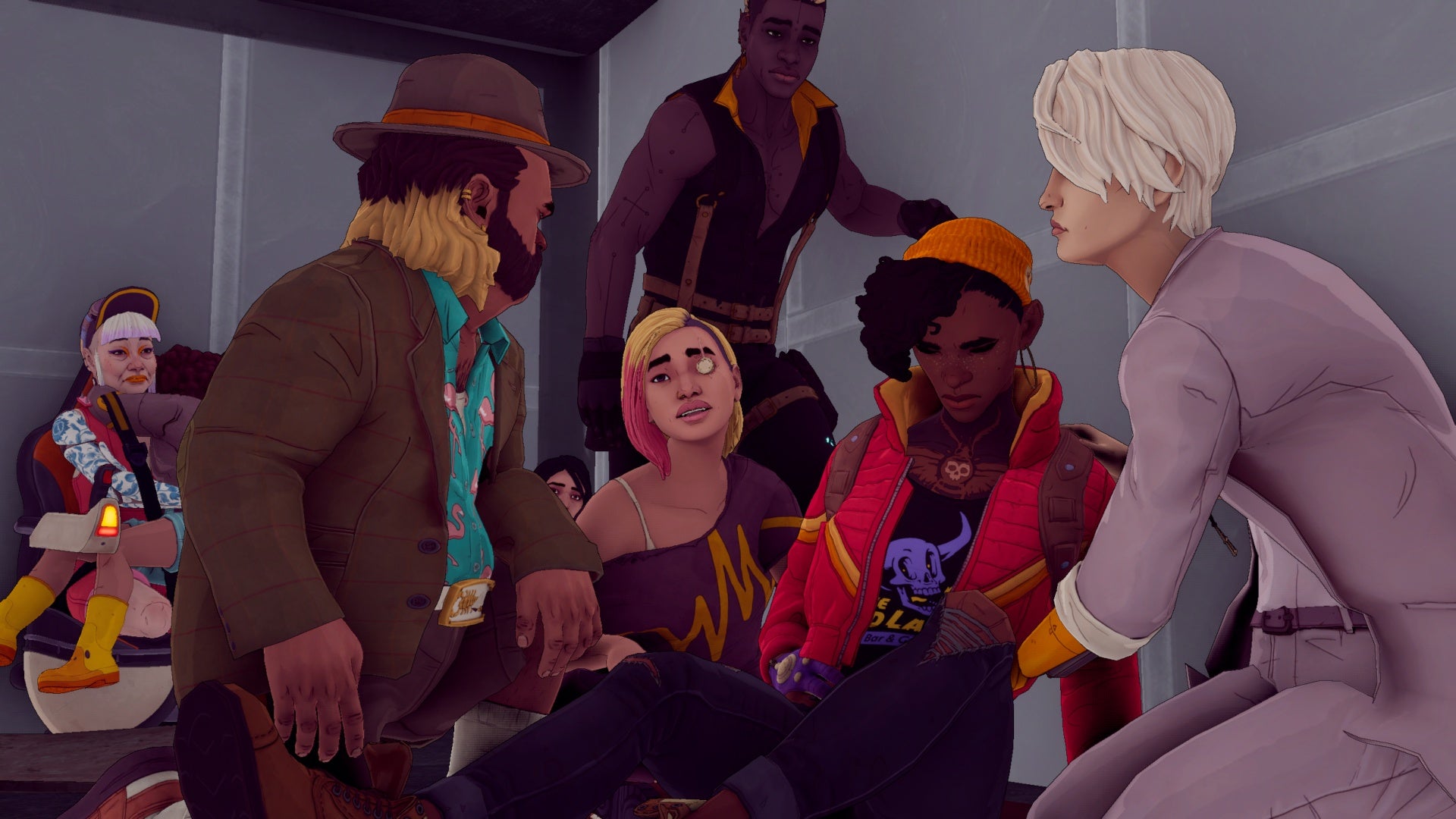
I grapple with the overall picture because I genuinely, truly appreciated the intimate moments in Dustborn. Before it added characters simply for the sake of it, it captivated me with stories of sisters reconnecting, downtrodden individuals finding hope in one another, and an oppressed group fighting for freedom in an unjust world. These were the moments that kept me engaged when new contrivances or convoluted twists interrupted my experience. However, these were the least intrusive aspects of Dustborn, as the combat remains the most egregious addition to its already overflowing content. It’s frustratingly imprecise, and Pax’s vocal attack arsenal lacks enough unique flair to give the game its own identity. The only redeeming aspect is that it allows you to opt out of combat early on.
The game’s rhythm sequences, featuring the titular Dustborn punk band, are somewhat better and offer a fair challenge, but I never eagerly anticipated them due to the uninspiring music. Perhaps this was intentional, given Dustborn is merely a front for smuggling, but I’m not rushing to add any of these tracks to my Spotify playlist. Dustborn frequently overextends itself, even in quick gags like a turn-based battle sequence paying homage to RPG classics. It’s not that these ideas are inherently flawed; rather, the execution never matches the high points of its relationship writing.
Screenshot: Red Thread Games / Kotaku
It seems I’ve spent much of this review criticizing a game I largely enjoyed. Perhaps this stems from frustration with its squandered potential buried beneath excess, like someone hesitating to say “stop” to the person grating cheese at Olive Garden. Part of me craves a game like Dustborn now—one that believes in the power of unity to change the world and, despite the chaos around them, maintains something worth fighting for. As I’ve aged, I’ve found myself slipping back into the cynicism of my youth. I’ve watched the world deteriorate as those who supported me were also worn down. How long must we unite and fight against systems that prefer our submission before change occurs? How much strength do I have left to find out? Large portions of Dustborn tapped into my anxiety about the world’s state, and despite its earnest belief in Pax and her friends’ ability to improve it, I find myself increasingly skeptical. Perhaps the world, much like Dustborn, isn’t simply good or bad, but full of good people making the best of their circumstances. I want to share the game’s optimism, and maybe that hope is enough for me to overlook its overambition.