


The gaming community hasn't given enough attention to the experience of mastering the original Ninja Gaiden on the NES. I understand why—it's famously difficult, embodying the "Nintendo Hard" challenge. Those endlessly respawning birds that relentlessly pursue Ryu Hayabusa still haunt my dreams. However, with dedication, practice, and memorization, you can bring down the 8-bit adversaries in a heartbeat with precise button presses. Once insurmountable obstacles transform into thrilling moments of "whoa, did I just do that?" where your reflexes outpace your conscious thought. If it weren't for the next looming threat, you'd bask in the sheer coolness of your achievement.
This comes to mind because The Game Kitchen's Ninja Gaiden: Ragebound perfectly captures that "whoa, did I just do that!?" feeling without the trial-and-error frustration of its predecessors. Even if the developers hadn't openly expressed their admiration for the series, their deep mechanical understanding of what makes classic Ninja Gaiden captivating is evident from just a few minutes of playing Ragebound. This team truly understands it.
Ninja Gaiden: Ragebound proudly pays homage to its NES predecessors from the start. It begins with the fateful duel between Ryu’s father and the enigmatic gray ninja that fans will recall from the first console Ninja Gaiden, launching Ryu on a revenge quest in the United States. However, Ragebound immediately sets itself apart by focusing on Ryu’s protege, Kenji, who remains to confront the rather small matter of a demon invasion. Ryu appears for a tutorial and a challenging boss fight to test new players but is absent for most of the adventure. Vengeance waits for no one.
Screenshot: The Game Kitchen / Kotaku
While the premise might seem like fan fiction (Kenji, Ryu's student, gives off the same vibe as John Freeman, who was Gordan Freeman’s brother), it effectively works on a metatextual level. Just as The Game Kitchen had to craft its own vision for Ninja Gaiden respecting its forerunners, we follow a hero who forges his own path using his master’s skills. Newcomers might miss some references and motifs if this is their first Ninja Gaiden, but the game remains accessible.
Kenji eventually encounters Kumori, a kunoichi from the Black Spider Clan opposing the Hayabusas. Circumstances force Kenji and Kumori into an uneasy alliance, leading them on a journey against both human and demon foes. The storyline shares familiar beats with the original Ninja Gaiden, even if Ragebound is a standalone side story. It's the Ninja Gaiden Gaiden, if you will.
You’re that ninja
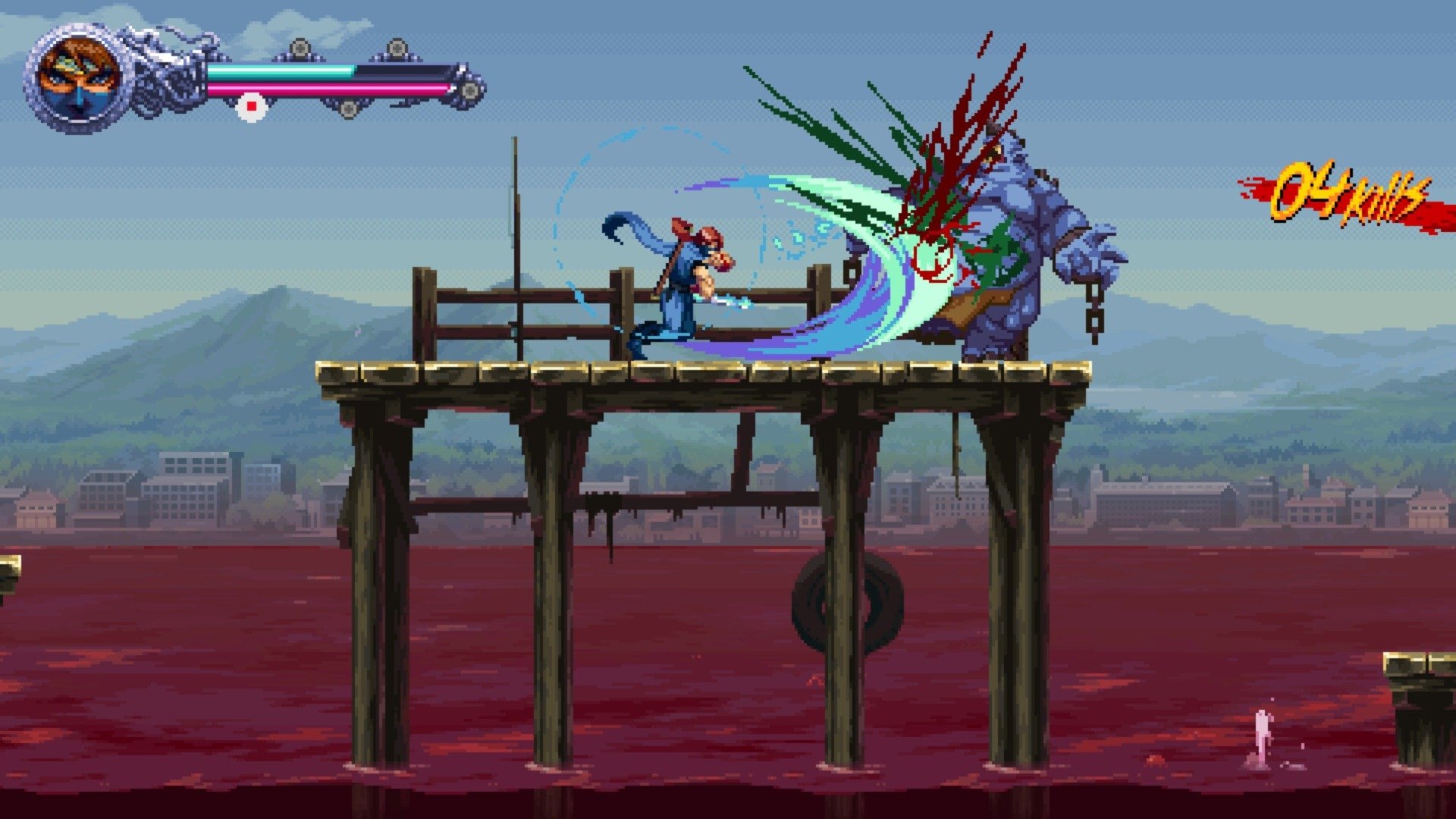
Though Kenji is Ryu’s disciple, he handles with the same fluidity as his master. Whether scaling walls, dodge rolling through unavoidable attacks, or executing aerial combos by bouncing off enemies, every button press is impeccably responsive. Despite Kenji’s vast array of attacks and movements, they're accessible through a simple control scheme reminiscent of an SNES game. Apart from a few very specific quirks (does my aerial attack have a cooldown?), I always felt completely in control while playing Ragebound
Trust me, I needed every tool available to succeed. The early levels are filled with enemies, leaving little time to react before taking damage. Yet, before I could fully process everything on screen, I’d instinctively perform a series of jumps, rolls, and slashes that cleared the area instantly. I didn’t rely on a single strategy; I intuitively tried attacks that felt cool, often leading to significant rewards.
While I’d love to attribute this to my hardcore retro gaming prowess, these consistent feelings of being so cool are a testament to how impeccably balanced Ragebound is. For example, most enemies fall to a single strike, but tougher foes require more effort. Meanwhile, glowing enemies offer Kenji a supercharged attack that slices through these formidable adversaries. This design encourages strategic thinking about the order of eliminating threats, and even in chaos, spotting a graceful way to deploy supercharged attacks on tougher foes felt natural. It helps that Ragebound features fluidly animated pixel art, making it easy to read enemy attacks. I didn’t master every encounter immediately, but I always had an idea of what to do differently to avoid hits or maintain combos.
Most importantly, Ragebound feels as good as it looks. The sound of cutting through enemies never grows old, and moments when the action pauses as Kenji uses a supercharged attack to split a massive foe in half truly convey the impact of the blow. I experienced a consistent stream of “whoa, did I just do that!?” highs, whether or not I’d rehearsed a stage. At times, I was completely immersed in a flow state, with just the right amount of adrenaline as I lived out ninja fantasies I hadn’t realized I had.
Despite its design encouraging precision, I always felt I had ample room for mistakes, and Ragebound quickly thrusts Kenji back into action after a death. Instead of encouraging mastery through failure, the game is so rewarding when played well that I never wanted to win by a narrow margin. It helps that each stage is visually and experientially unique, with no repetitive challenges, even when bosses reappear. I could do without the two short vehicle-based autoscroller stages, but otherwise, every level is a hit.
I can’t believe it’s not Tecmo
Ninja Gaiden: Ragebound brilliantly evolves the gameplay of its classic 2D predecessors, feeling fresh and modern yet familiar. I wish I could say the same for its storytelling. While plot isn't typically a focus in retro revivals like this, the original NES Ninja Gaiden was a pioneer in narrative. The original manga-style cutscenes were well-executed given their limitations, aiming high with surprise deaths, major plot twists, and a climactic finale. It’s not mind-blowing by today’s standards, but stage-based action games in 1989 didn’t usually have this level of storytelling (settle down Astyanax fans, I see you).
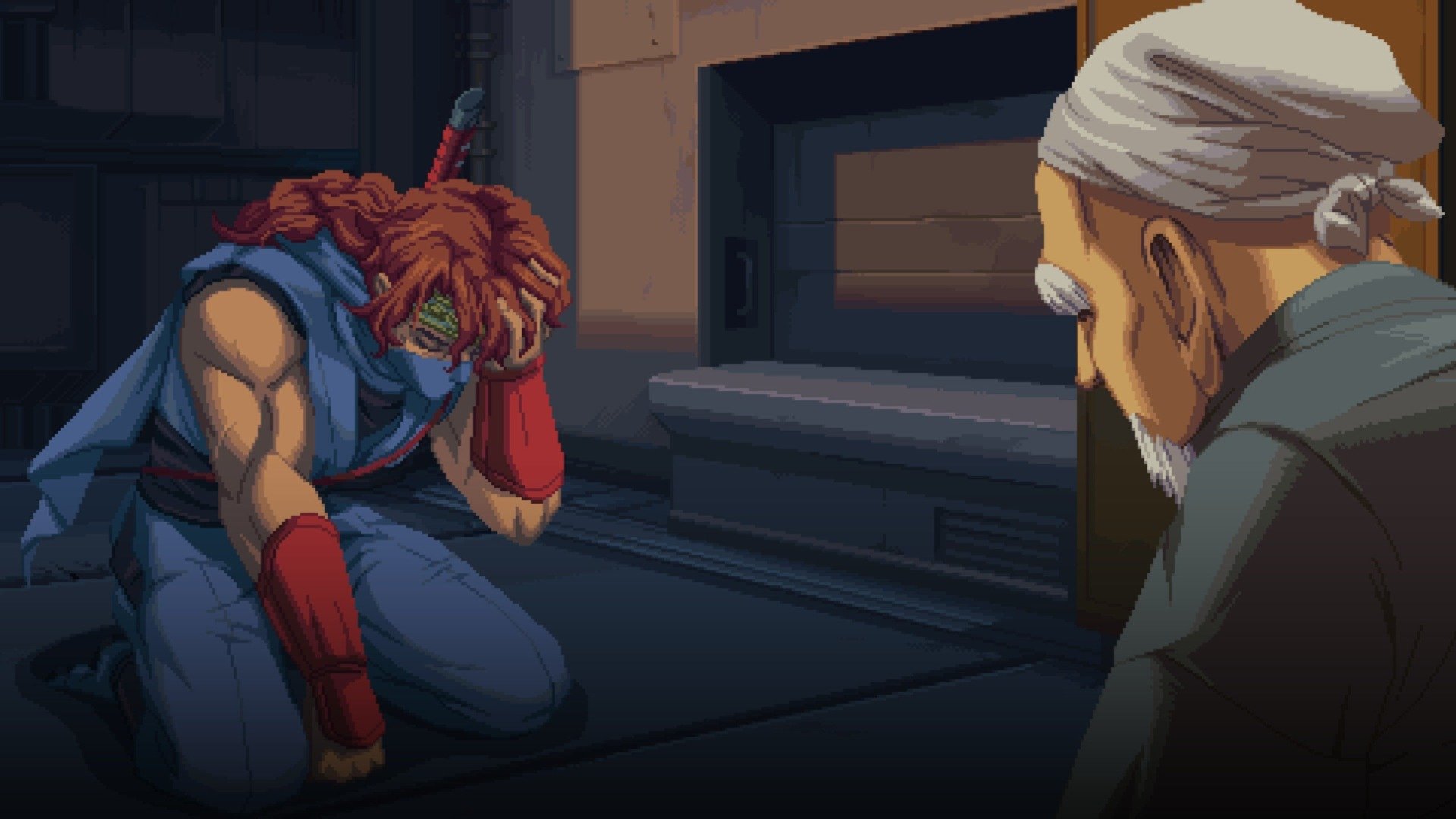
Ragebound starts strong narratively. The Game Kitchen uses its signature art style from Blasphemous to create impressive cinematics that lovingly honor the series' roots. However, once the game enters its third act, the story devolves into brief exchanges between frenemies Kenji and Kumori, lacking excitement. I’d argue that 1989’s Ninja Gaiden makes Ragebound feel simplistic by comparison. There are occasional twists, but I never felt particularly invested in the unfolding events.
Screenshot: The Game Kitchen / Kotaku
It's unfortunate because Ragebound ends on a note that should have been impactful had the buildup been better. The moment in question didn't linger enough for reflection, causing the ending to feel like awkward tonal whiplash. Even ignoring the story, I felt Ragebound concluded an act too soon. The final set pieces felt more like "rising action" than a "story climax," noticeable even to those who skip cutscenes. By the final boss, my thoughts were less "oh, this is it!" and more "oh, this is it?" It's a disappointing end to an otherwise excellent journey.
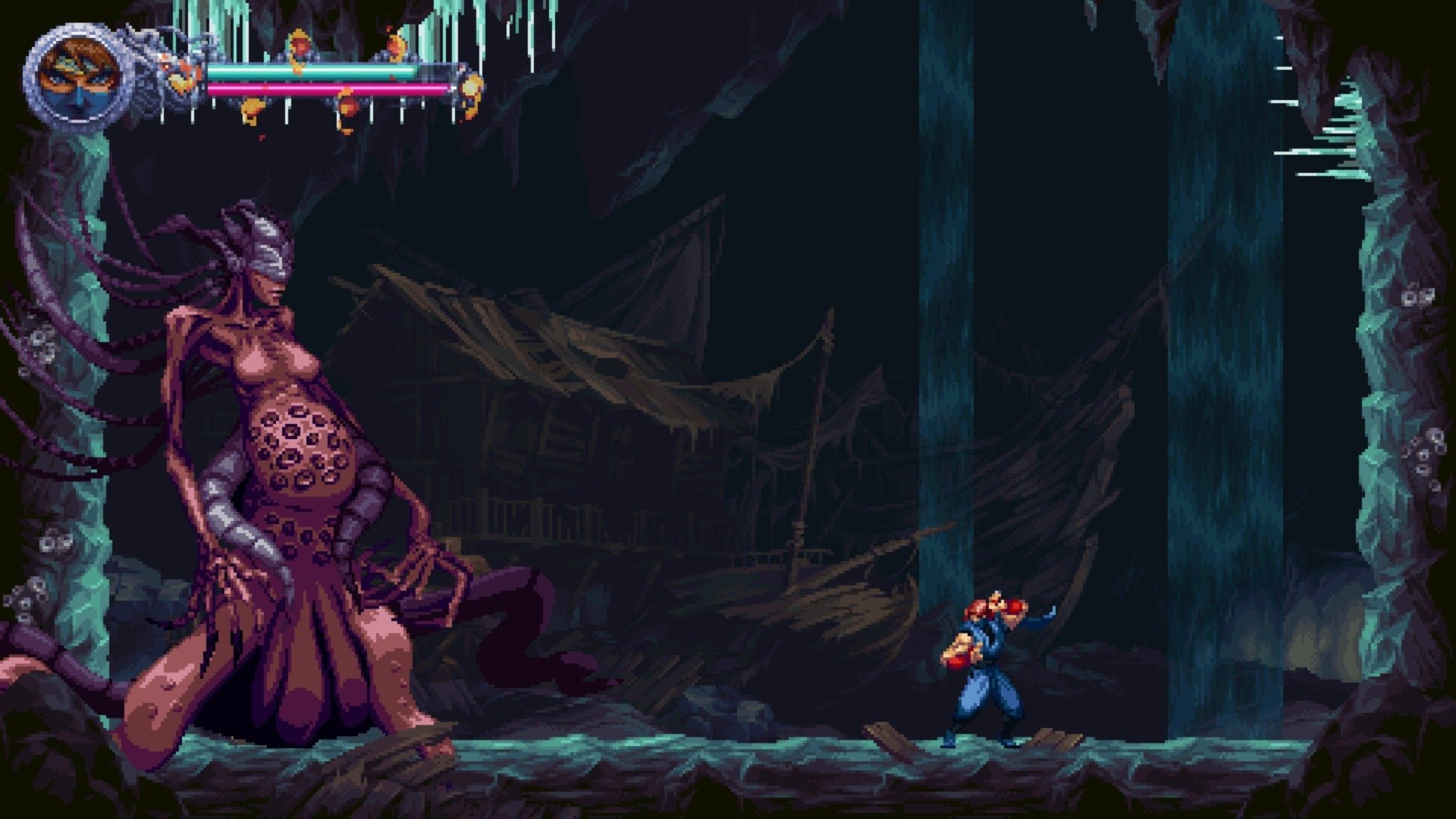
It’s Blasphemously good
I could nitpick Ninja Gaiden: Ragebound further. Hitboxes occasionally seemed too large. I disliked a few enemy types near the end. The unlockable hard mode altered an early boss in a way that felt rigid, creating an uneven difficulty spike not matched again in that playthrough.
Multiplatform
Ninja Gaiden: Ragebound
BACK-OF-THE-BOX QUOTE
"2D Ninja Gaiden is back, and it’s not a Metroidvania!"
TYPE OF GAME
Fluid 2D action sidescroller for retro enthusiasts and score attack fanatics.
LIKED
Perfect controls, deeply satisfying hitstops, fantastic pixel art, stellar tunes, great replay value.
DISLIKED
Some enemy hitboxes are too rigid, story lacks punch, feels like it ends an act too soon.
DEVELOPER
The Game Kitchen
PLATFORMS
PS5, PS4, Xbox Series X/S, Xbox One, Switch, PC (Played)
RELEASE DATE
July 31, 2026
PLAYED
Roughly 14 hours. Cleared the game on normal and hard mode. Finished all bonus stages and found all collectibles. Replayed some stages shooting for higher ranks.
Nevertheless, a few criticisms and an underwhelming finale haven't deterred me from returning to Ninja Gaiden: Ragebound, even after gathering everything I needed to write a review. The moment-to-moment gameplay feels so good, and the diversity between stages offers unique, worthwhile challenges. I’ve never considered myself a high score chaser or a speedrunner, but as I write this, all I can think about is picking up my controller and chasing max ranks on stages. Not because I need to prove anything or unlock content, but because I want to see what other combos or tricks I can execute. In a modern gaming landscape where we often need a slow drip-feed of rewards to keep playing, it's refreshing to see a game with such high replay value simply because it's that well-crafted and concise. The act of play itself is its own reward.
Ninja Gaiden: Ragebound captures nearly everything that made 2D action games of the past exceptional while smoothing out the rough edges associated with that era. It looks spectacular, controls like a dream, and features levels worth experiencing repeatedly. It does end too soon for its own good, and its brief runtime may put some off. However, the developers at The Game Kitchen have proven themselves masters of their retro-inspired craft with this game. Ninja Gaiden: Ragebound is a worthy successor to its NES predecessors, without a boomerang bird in sight.


